—Michael Upton—
In the Spurtle on 29 May, Mike Worobec argued for two changes to the New Town’s communal gardens; first, an ‘expert-led’ programme of gardening and silviculture to ‘restore’ them, and secondly, allowing the public to ‘move through’ the gardens.
The author was sparing about details, but advocating a citywide programme is presumably an argument for some public power or authority to take the matter in hand.
His arguments are threefold.
Unsurprising growth
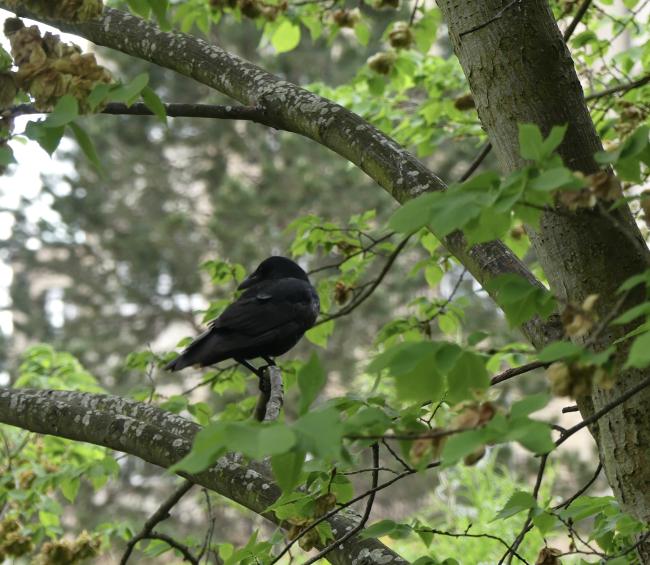
First, he writes that since the gardens were created in the late eighteenth and early nineteenth centuries, ‘Trees have surged upwards and outwards, self-seeded growth has taken hold, hollies and dense understorey have crowded out light and space.’
It seems odd to be vexed that trees and bushes grow. Certainly, early prints of the New Town show less vegetation in the communal gardens. That would be because they had just been planted. Mr Worobec speaks of restoring the original designers’ vision, as if to doubt that their vision was that the trees would grow. It’s what trees do.
But Mr Worobec says that in the past the gardens ‘were curated. But today, that curatorship has been lost’. He is silent about when this is supposed to have happened. Nor does he acknowledge the fact that the gardens have always been managed – curated if we really must – by committees of their owners. They would be surprised at the ignorance of the paid work of their contracted gardeners, and the voluntary work of the communal owners themselves, past, future, continuing.
Mr Worobec expresses concern that ‘overmature’ trees may fall. In this safety-obsessed age, this is of course the standard excuse for felling beautiful trees. But, sadly, the owners of our communal gardens are all too aware that the modern culture of litigation requires them to pay for costly public-liability insurance and tree surgery. Yes, parked cars and even people will from time to time be injured by falling boughs and trunks – from trees in communal gardens, and also trees in private gardens, trees in public parks, and trees in the countryside – but we cope, as we have since we first climbed out of them; with common sense.
Circumnavigation
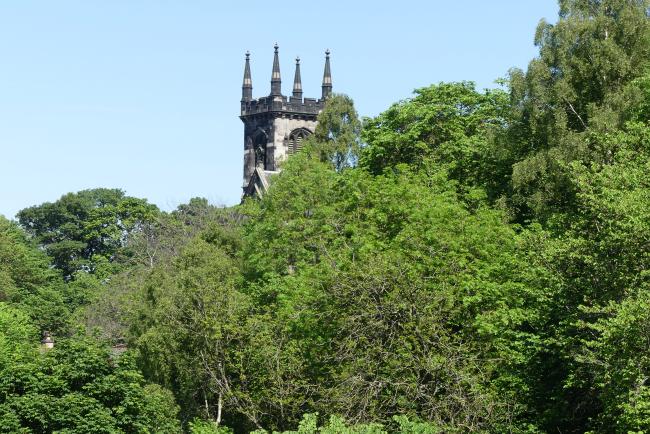
Mr Worobec’s second argument is that the communal gardens get in the way, because people have to walk around them. Whatever connection this has with his concerns about plants growing bigger, it seems rather arbitrary. What principle is he invoking here? After all, it is a long walk from, say, Annandale Street by East Claremont Street to get to Broughton Street. How much easier it would be to get to Tesco if we could have a public vennel through one of the tenements on, say, Claremont Crescent. Or if private houses are to be more sacrosanct than private gardens, Edinburgh has no end of sports grounds which the long-suffering pedestrian has to walk around; should they not equally be subject to calls for public access?
It is strange to complain that the street-plan of every city in the world involves using the public routes to circumnavigate the private properties. Edinburgh’s past two centuries do not seem to have recorded many pedestrians succumbing to exhaustion from the great effort of walking around Queen Street Gardens.
Level of usage
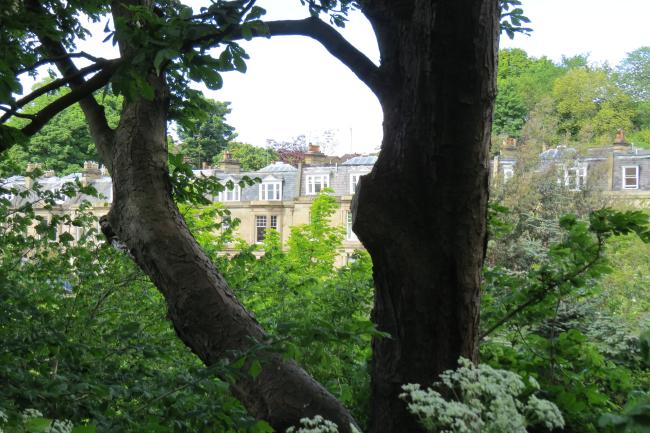
His third argument is that the communal gardens are ‘barely used’. He is reticent about his evidence. After all, it is Mr Worobec who tells us that he cannot see into or through them. Perhaps he has undertaken some methodical survey? And if so, then what level of usage does he demand? Is it to be measured against some surveyed intensity of use of private gardens, or public parks? We can only speculate what that would tell us about hourly-usage-of-square-feet across the city. You could be in Inverleith Park some evenings this month and have the whole place almost to yourself – but so what? Does that mean undergrowth must be uprooted or new paths or roads driven across it?
But let us suppose he is right; certainly, all things being equal, communal gardens are presumably less frequented now than public access would entail. But advocates of the right to roam for Homo sapiens do not always think of other species. The fewer folk in the New Town’s gardens, the more wildlife. The foxes can tell you. So can the squirrels and the birds. There are New Town gardens that are home to otters and their young. Insofar as our communal gardens are actually overgrown and unfrequented, the more they are sanctuaries for wildlife. Is that then such a bad thing? How long would otters and public access co-exist?
What in any case is the principle Mr Worobec invokes? Are we to say that if any given piece of private property is not used to a satisfactory level of intensity, then public access must follow? What if we were to find that a spare room in, say, Bellevue was lying empty?
Mr Worobec’s attention is attracted to the New Town’s communal gardens because they are shared and on public view. There are thousands of completely private, unshared gardens which exemplify overgrowth and exclusion. But only communal gardens which reflect Scottish traditions of communal living evoke this wish to interfere. And only where the designers placed them in front of the houses, so as to make the city beautiful for everyone. Those who were canny enough to put them out of sight, within the housing blocks, are to be left in peace (and there are such gardens in the New Town). The lessons for the future are clear; if you do not want your property to be subject to calls for public intervention, then hide it round the back – or better still, do not share it with anyone at all.
Is that the kind of society we wish to create?
Troublesome practicalities
Mr Worobec is silent about other practicalities. Section 6 of the Land Reform (Scotland) Act 2003 unsurprisingly places control of access to communal gardens with their owners. If Mr Worobec wishes to proceed consensually, who then is to undertake the work of contacting all of the owners of all of the communal gardens to seek their consent? Is someone going to provide money just to pay for the time such an exercise would take?
Insofar as agreement was not forthcoming, what then? Does Mr Worobec contemplate Parliamentary revision of the 2003 Act? He may know that the Edinburgh legislature does not have the power to make laws contrary to the European Convention on Human Rights.
The reason why we have Section 6 is to comply with the protection of private life and property provided by the Convention. Westminster of course could override that. Calls for derogations from the Convention are fashionable in some quarters. Is Mr Worobec joining those voices?
The other practicality about which he is silent is money. Park-keepers incur costs in keeping their parks as parks. Gardeners incur costs in keeping their gardens as gardens, The co-owners of the New Town’s communal gardens incur costs in keeping up their communal gardens. So this desired public access then; are we to have private gardens for public enjoyment at private expense? Or is the money to come from the Council (try asking), or from Mr Worobec?
Or our collective philosophy could just be: live and let live.
On a personal note, I must declare a lack of interest. I have lived for decades in a tenement overlooking three communal gardens and have no right to any of them. We all have just the same vested interest in cherishing their beauty; the beauty with which our city is adorned by the work and the money of the gardens’ owners.
Got a view? Tell us at spurtle@hotmail.co.uk
*****
Dear Spurtle,
Interesting piece on a time-old debate.
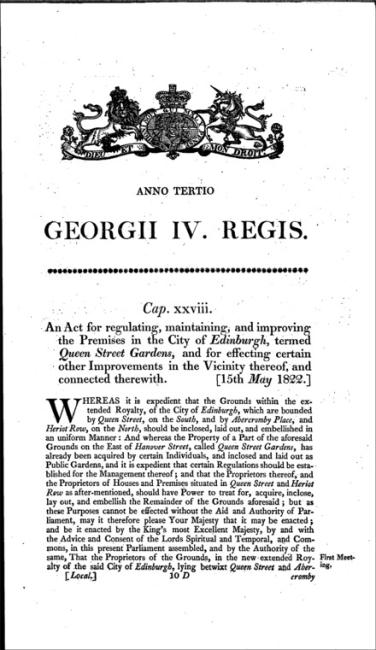
I understand the gardens are created and upheld by Act of the (UK) Parliament (see, e.g., here), so I don't see how that gives Holyrood or Edinburgh Council automatic right of access.
Also, I can't speak for the East or Central Queen Street gardens, but a cursory look at the West ones will show large spaces where elderly or diseased trees have been removed and replaced as well as other aspects of management.
Perhaps it might have been wiser for Mr Worobec to have consulted with the management committees of each garden before assuming their neglect.
John
*****
Dear Spurtle,
While we look forward to Mike Worobec’s response to Michael Upton’s eloquent arguments against the opening-up of the New Town’s communal gardens, I’d like to offer my personal perspective on why, in the age of Entitled Tourism, this is such an unwelcome idea.
Entitled Tourism – different from, but a function of, overtourism – is a growing phenomenon that will be familiar to most Edinburgh city centre residents. While many visitors are still content to view the capital’s sites from behind the smoked-glass windows of one of the enormous coaches which prowl the streets, more and more seem to enjoy a proprietorial wander on foot around our neighbourhoods.
They sit on our doorsteps to eat their snacks and scroll through their phones. They take photos of picturesque basement properties (and their startled occupants). And they hover expectantly round our communal gardens, rattling the locked gates and even occasionally trying to scale the railings to gain access.
These are the Entitled Tourists of the 21st century: people who view the places they visit not as communities where residents live their lives, but as theme parks where nowhere should be off limits.
For those of us city centre tenement-dwellers who don’t have our own back gardens – and I suspect that’s most of us – membership of the New Town’s communal gardens offers peace, tranquility and the chance to enjoy some respite from the sense that we’re just extras in a kind of Disneyfied ‘Edinaland’.
David Jackson Young
P.S. News just in: it seems proposals by Councillor Dan Heap for increased public access to Edinburgh’s private gardens have been defeated, albeit very narrowly.
Councillor Heap is quoted as saying, ‘It just doesn’t feel right’ that these green spaces should be behind locked gates.
Presumably his own backyard, if he’s lucky enough to have one, is open to one and all? That would ‘feel right’, wouldn’t it?—DJY
*****
Dear Spurtle,
David Jackson Young warn of ‘Entitled Tourism’ and losing quiet in Edinburgh’s New Town. For tenement dwellers without private gardens, these spaces are a vital escape from the ‘Disneyfied’ bustle — but locking them up only worsens two big problems.
First, overcrowding: nearly all visitors are funnelled into the single overstretched core of the Royal Mile / High Street. Opening gardens would disperse crowds, ease the scrum and make the whole city nicer for residents and visitors alike. Clear rules — set hours, quiet use, no commercialisation — would stop trespass and preserve calm.
Second, we face a growing loss of Edinburgh’s unique character. Massive overgrowth of ageing trees and thickets is choking our historic vistas: the famous views across the Seven Hills, down terraced streets to the sea, and the sweeping lines of crescents, facades and masonry are vanishing.
Instead of light, air and that open majesty the New Town was designed for, we get deep shade, damp and blocked sightlines. Proper management — not just leaving vegetation to run wild — is needed to restore the beauty and brightness these spaces were meant to frame.
Legally, Section 6 of the 2003 Act allows voluntary agreements; costs can be shared. As Cllr Heap said, it doesn’t feel right that prime green space stays locked while so many have nowhere to go.
We can have both: quiet enjoyment for residents, and a well‑cared‑for, accessible city that lets Edinburgh’s true glory be seen again.
Mike Worobec
*****
*****
*****
For the New Town Flaneur’s typically idiosyncratic response to this debate, see Letters (9 June 2026).